Unit 1
In the conclusion of Tony Morrison’s Black Matters, Morrison offers an interesting perspective on freedom, specifically how the creation of freedom was only possible because of slavery. Conceiving the idea of freedom requires a state where freedom doesn’t exist. Because people can point to slavery as the antithesis of freedom, it can be actualized. If everyone experienced freedom, there would be no understanding of freedom as a privilege or how it can be taken away. I find this really interesting because as America’s ideals were conceived from the wrongdoings that American colonialists experienced from England. The reasoning behind the migration to the new world was for the Puritans to escape the tragedies in England and to start a new, better life. Despite America’s founding values, however, the same wrongdoings that people sought to escape were subjected to other people through slavery. I found this very thought provoking and was very disturbed at the blatant hypocrisy of freedom. This reminded me of the problem with Thomas Jefferson in which it is important to understand his hypocrisy as a slave owner and the author of the Declaration of Independence. How was it that slavery could exist in a world built on escaping hardship?
Unit 2
What I found really interesting about Thursday’s lecture was the presentation about how certain words have no translational counterpart to other languages. My dad used to live in Germany, and sometimes, while talking to us, he will say: “there is the perfect word in German for this, but I don’t know how to explain it in English.” It’s as if language is a paradigm for knowledge production, that different languages have the vocabulary to explain different scenarios. Some languages do not have words to describe ideas/concepts because under that linguistic paradigm those ideas/concepts are not seen as valuable. Furthermore, different countries with different cultures and languages, produce different types of knowledge. Chinese medicine, for example, is seen as valuable in China, and so the Chinese language has words to describe aspects of Chinese medicine that English and other languages cannot account for. Different cultures find value in different things, and the vocabulary defines what contains value. It is a possible explanation for why the British historian T.B. Macaulay thought that all of the knowledge ever produced in Persia was only as valuable as one bookshelf of European books. Although Persia was producing incredibly significant academic work at the time, Macaulay could not understand it from his own conceptual paradigm.
Unit 3
In Chapter four of Regarding the Pain of Others, Sontag discusses how photos of dead/dying individuals are more widespread when the subject is non-white. She talks about how “the more remote or exotic the place, the more likely we are to have full frontal views of the dead and dying” (70). The farther and less white and American, the more differences we can see between us and the subject. Sontag discusses how photos of American soldiers dying always have their faces blurred, or disfigured, so the viewer cannot make out a distinct person. However, if the subject does not look like the viewer, less will be censored because it is less shocking to see someone suffering who the viewer cannot relate to. Gourevitch talks about how Americans faced away during the Rwandan genocide, but still took lots of photographs of the fleeing Hutus, the Cholera outbreak, and the dead bodies that were being cleared in the aftermath. Gruesome, personal images were widely produced in America because Americans had little to no connection with the murdered Tutsis, and could not imagine themselves or close relatives in the same position.
Unit 4
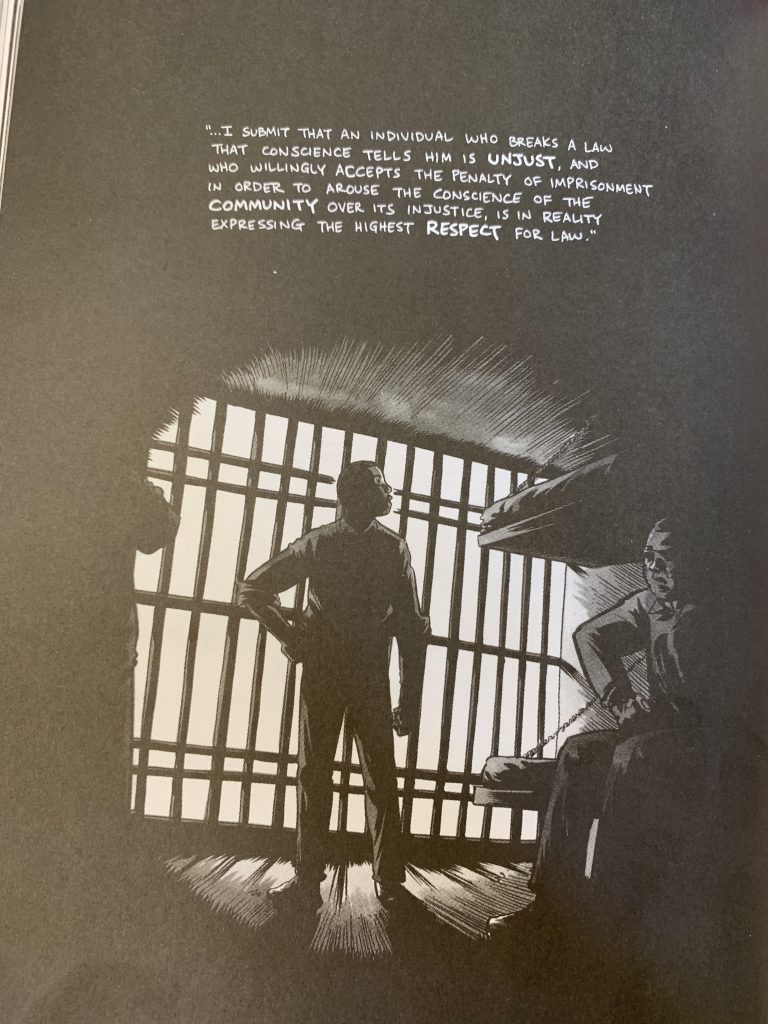
In this picture, the shadowing and light make it seem like Martin Luther King Jr. has left the light of the world and has been transported to the darkness of prison. It is as if the bars separate the light from entering the cell, and this metaphor between freedom and imprisonment can be shown through the lighting of the cell and background. However, the light seeps into the jail cell, and it makes it seem like he is supported by the light that shines behind him, that the prison cell was completely dark until he walked in. This, coupled with the text that posits willingly acting against the law to better the community shows “the highest respect for law.” Although MLK broke the law, and as a result is shoved into the darkness of the prison, the lightness seeping in the cell demonstrates the highest respect for his community, as he is willing to break the law to fight against the injustice that occurs.
This emphasizes the effort that prominent civil rights activists put into fighting injustice: one of the figureheads of the movement was willing to face jail time to create the change that his community deserved. The black borders make it seem like he is being swallowed by the jail, but at the same time his posture, with his fists curled up and head held high hand at the waist in a pose that exudes courage and strength. This gives the viewers hope that his sacrifice is meaningful, and it stresses MLK’s ability to inspire people and stay strong in the face of opposition. The fact that this panel takes up the entire page also emphasizes the historical importance of MLK’s imprisonment and choice to sacrifice his own wellbeing in order to oppose unjust laws. The panel gives me a heightened understanding of the bravery it required to march in protest of segregation while knowing one could be arrested.
Unit 5
Pellegrini and Derrida’s work on “parricide” (105) and the archive is really interesting. They discuss the archive’s role in obtaining performance and equate it to parricide. The word parricide is interesting here because it refers to the killing of a parent, which at first glance makes no sense as to why this would be applied to an archive. But what Pellegrini refers to is the archive killing the father of the work it seeks to remember. Because the archive needs remnants of performance to survive, it partakes in a “parricidal impulse as productive of death to ensure remains” (105). In other words, the idea of an archive supports the killing of the author to ensure that there are remains that can be preserved. Because the archive’s purpose is to preserve, without anything to preserve the archive can no longer survive. Furthermore, if nobody died, there would be no need for archives because memories would live on in the individual. The archive needs the death of the individual to produce the memories that it survives from. This explains why Schneider refers to performance as: “as antithetical to memory as it is to the archive” (101) because with performances there are no remains to be collected nor an original version to be preserved, the archive “demand[s] that performance disappears in favor of discrete remains” (102). Performance itself constitutes an end to archives because it cannot create the memories the archive needs to survive, as performative acts are ephemeral, and their value is derived from their disappearance.
Unit 6
Snow’s article about the separation of academic fields is quite interesting. Snow argues we live in a world that is increasingly reliant on specialization in a specific field of knowledge, and that there is little desire for interdisciplinary studies. However, there is a realization that a wide variety of knowledge is often needed to solve most problems, and that specialization of knowledge takes away from our ability to solve these problems. Furthermore, there are not many established pathways of communication between literary academics and scientists, which makes it hard for specialized fields to work together to solve problems. It is interesting hearing this from the perspective of a liberal arts student because I am in constant communication with people who are interested in vastly different topics than I am. My roommate for next year wants to be a biochem major, and I want to be an econ major, and, as our studies are constants in our lives, we discuss course content often. Although we don’t often find each other’s material as interesting as the other, this constant communication helps us bridge that gap, and we have different yet equally valuable approaches to problems. Furthermore, we are all required to take classes in other fields of knowledge, which helps us make these connections with professors and students that normally would not fall into our known circles. I’ve found the liberal arts to be incredibly valuable for problem-solving, and I hope I can take my particular skillset into the world and solve problems.
